
How to Keep Your Business Running on Low-Energy Days (My 20% Plan)
Quick answer: The week you most need your business to run is the week that you have the least to give it. So I don't figure it out in the hard week. What I have is a plan that was already made on a better day: a really short must-do list, a clear idea of what can wait, and the tools that are already doing the heavy lifting.
Yesterday I was at maybe 20%, maybe even less. And on a day like that, I can't sit down and figure out what to do. I just don't have it in me.
Here's what I noticed though. There are really two kinds of low. There's the low where you have the time but not the mental capacity. That's usually a day, unless you're in burnout. And then there's the low where you just don't have the time, and that can be a whole week. The good news is the plan is the same for both.
The thing is, a business that only runs when you're at 100% is not a sustainable business. I've learned this. One hard week and the money stops right along with you. So I don't figure it out in the hard week, and I don't recommend that you do either.
Here's my actual low-energy week plan: what has to happen, what I let go of, and how I set it up so it's ready before I need it. And I'll tell you right now, it's a lot less than you think.
You can either keep reading or watch the video:
Step 1: Your must-do list (the 3 to 5 things that keep money coming in)
When you're at 20%, everything on your list can feel urgent, and that's usually when people freeze. You open the laptop, you see a bunch of different things, and you can't pick one.
So the first part of the plan is a really short list. Three to five things, that's it. The things that keep money coming in and keep clients taken care of.
The question I ask myself is: what can move my business forward without requiring more time and mental capacity from me? And when I'm deciding if something makes the must-do list, I check it against three things:
Does it go out into the world?
Does it keep something selling?
Does it move forward without me hovering over it?
If it doesn't do one of those things, it's not on the list for the hard week.
Here's what's actually on mine. There are four, and they go in this order:
Client work. That comes first every single time, because I want my clients to always be taken care of.
Checking my email and replying to the important ones. That could be student questions, collab opportunities, that kind of thing.
YouTube, because that's my main platform and that's what brings in most of my business.
Anything on my list that has to do with a launch or a new product.
That's it. That's the whole list.
And here's the part that takes the pressure off. They don't all have to happen every single day. They usually do. I'd say they need to happen almost every day. But when I'm really low, I might only get to one or two of them. And that's okay. I've given myself permission for that to be okay, because I can just make sure that I catch up on the other two the next day. The list doesn't change, only how much of it I get through.
And if it's a low-time week where I just don't have the hours, I focus on those four all week, and that's it.
Oh, and one more thing that might sound a little weird, but it works for me. Some days I'm low, but I actually have the time. I just don't have the mental capacity. On those days, once my priorities are done, I'll dive into learning something. And honestly, for me, learning usually sparks something that gets my business juices going again.
If you're not sure which parts of your business would slip on a hard week, my free Systems Audit Tool walks you through where things are slipping and the parts that are already solid.
And if you have no idea what would even go on your list, or you just can't think about it right now because you have too many things going on, that's okay. That's actually why I started something new called Simply Supported. It's for people running a business in the tiny gaps: moms, ADHDers, caregivers, people working full time and starting their business in the evenings. Anyone running on low spoons or low time. Every week you see how I actually run my business, you can send me the thing you're stuck on, and there are tools and templates ready for the days that you can't build anything. There's no calls that you have to show up for. Right now I'm only opening it to a small group of founding members, and I'm doing that through my email list. No pressure ever.
Step 2: What you pause, push or hand off
Once you know what stays, everything else gets one of three labels: pause, push, or hand off.
Pause is for the stuff that can just stop for a few days and nothing bad happens. For me, that's any content other than my long-form YouTube videos. Social posts go first. They're just the extras at this point. YouTube is my main platform, so that's the content that stays. Everything else can wait.
And here's the fun part. I don't even have to touch them, because Claude actually reschedules my social posts for me. (I walk through how I use it in my Claude content workflow post.) So that one's a pause and a hand off at the same time.
Push is for the things that still matter, just not today. For me, that's the little admin stuff, like tracking revenue. It still gets done. It just doesn't have to get done on a 20% day. I don't even have a due date for revenue tracking. I just do it as the sales emails come in. So on a low day, I leave those emails sitting there, or I snooze them and they pop back up when I'm ready. Nothing gets lost. It's just waiting for me. For my other admin tasks, I just move the due date in Asana. Easy peasy. That way it's off today's list without falling off my radar.
And one thing I always push is big business decisions. I've learned not to make them on my low days. Otherwise I would just want to quit. It's not like the feelings aren't real. They're there, but my nervous system is just not a reliable narrator. On a hard day my business looks like it's falling apart, and on a good day it looks like it's just getting started and I have a million ideas. Same business. Different brain. So big decisions wait.
Here's one that surprises people: product building doesn't usually get pushed unless it really has to. Once I've made my mind up about something, I like to stay on top of it. That's things like my launches and my new products, the priority from my top four, and it's the stuff that keeps money coming in later. So it stays.
Hand off is anything that still needs to happen but doesn't need to be you. And honestly, right now most of my hand-offs aren't even people. They're the tools that I already set up:
Claude reschedules my content and takes care of a lot of the busy work.
Ivorey runs all the outward-facing stuff, so people can still find me, buy, and get what they paid for.
Asana remembers everything for me, so I don't have to hold any of it in my head.
So on a 20% day, those three tools are doing the heavy lifting, and I'm just showing up for my top four.
Now, the part people worry about most: telling clients. Honestly, most of the time I don't, unless I'm out sick for a whole week with the flu. My clients don't hear anything different from me. That's because client work is number one on my list, so even on a 20% day it's the first thing that I do. My clients are flexible as well. They don't need urgent things from me, which is something I set up intentionally. I don't work with clients who need me glued to my computer.
It also helps that I set windows for replying a long time ago, once or a few times a day instead of being available constantly. When my daughter went into burnout, that's what saved me. Nothing fell apart. Clients didn't disappear. Projects didn't stall. People just knew when to expect a reply, and that was enough. (More on how I run things async in How I Run My Business With No Calls.)
Step 3: Set it up ahead of time, so the plan is ready before you need it
This is the part that makes everything else work. But I have to be honest with you here. As much as I preach "write everything down and put everything in Asana," my top four aren't actually written anywhere. I just know them. Prioritizing like this comes naturally to me.
But I know that's not how it works for a lot of you. It's actually the exact thing my ADHD clients struggle with, and it's a big part of why they come to me. So if it doesn't come naturally to you, that's okay. But you do need to write it down once and have it somewhere you can reference.
And you can't write this plan in the hard week. It has to be on a good week, because when you're at 20% you don't have the capacity to decide what matters. On a good week, write down:
Your must-do list
What can wait
What's already handled for you
Then put it somewhere you'll actually see it on that 20% day. That way, on the hard day, you're not deciding anything. You're just reading what the good-week version of you already decided.
A few other things carry me through those weeks without me thinking about it:
My content prep tasks recur, so they just show up in Asana. I don't have to remember to schedule anything.
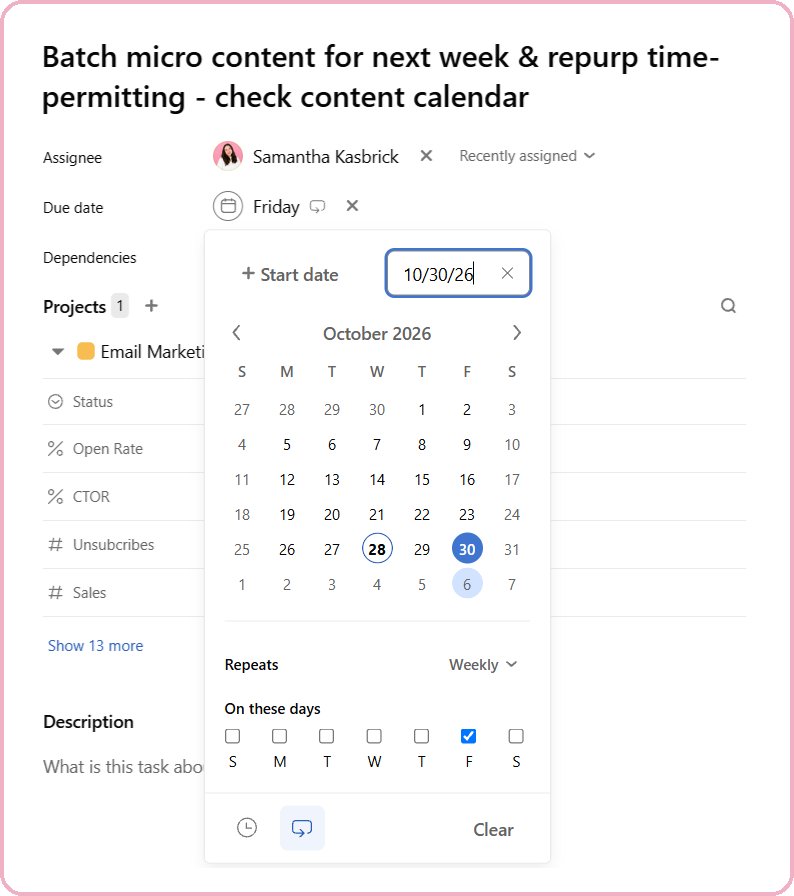
My content process is templated, so on the days that I can barely think, I don't have to. I just follow the steps that are already there. (I wrote more about this in the 3 things that kept my business running when I couldn't.)
I batch my YouTube videos every two weeks, but I always try to be one month ahead, so a bad week or a sick week doesn't mean a missed video.
My relaunch tasks are templated to start on their own two weeks before the promo, so launches don't depend on me remembering them when my brain is full.
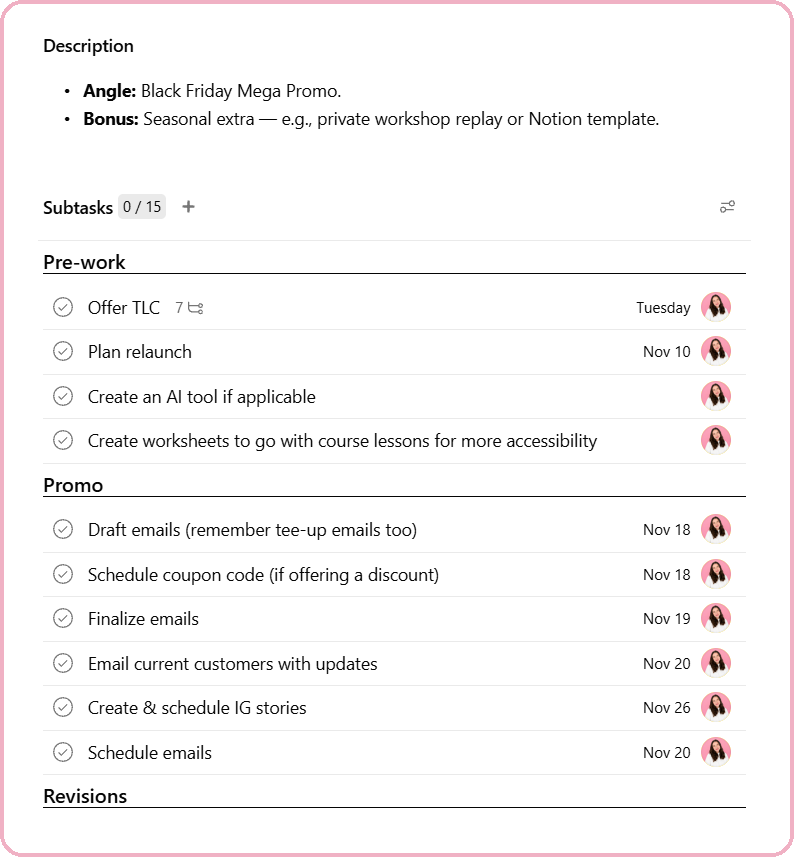
The goal isn't to post while you're having a hard week. The goal is to be far enough ahead that it doesn't matter. Even one buffer week feels completely different.
The same goes for how people buy from me. During my hardest season, sales still happened, and I didn't have to lift a finger. Somebody bought, they got exactly what they paid for, and they got their next step without me being anywhere near it. That was set up once, on a good day, so it works on the bad ones.
And I'll be honest: when a sale comes in on a low day, it really picks me up. I know it probably shouldn't affect me as much as it does, but it does. I'm grateful for each and every sale.
None of this is about having a perfect week. It's about getting it out of your head while you can, so the bad weeks don't get to take everything with them. It doesn't cost you a client. It doesn't cost you money. And it doesn't cost you your trust in yourself.
What's next
This plan works best when you're already ahead before the hard week shows up, and that comes down to what you do on the normal days. I walk through the small daily routine that keeps me about a month ahead in My Daily Asana Routine That Keeps Me a Month Ahead (Even on Hard Weeks).
Questions people ask me
What if I don't have the time and energy to set this up?
Then don't do it in the hard week. You can't write this plan when you're at 20%, because you don't have the capacity to decide what matters. Do it once on a good week: your must-do list, what can wait, and what's already handled for you.
What if prioritizing just doesn't come naturally to me?
That's okay. It's the exact thing a lot of my ADHD clients struggle with. You do need to write it down once and have it somewhere you can reference. If you can't decide because prioritizing is hard for you, you can join Simply Supported and I'll tell you exactly how to prioritize it.
Do I need to tell my clients when I'm having a low week?
Most of the time, I don't, unless I'm out sick for a whole week. Client work is first on my list, so it gets done even on a 20% day, and I set reply windows a long time ago, so a low day doesn't look any different to my clients.