Why You Can't Start a Task You Know How to Do (3 ADHD + PDA-Friendly Fixes)
Quick answer: If you can't make yourself start a task you already know how to do, it's not that you don't know how, and it's not that you're lazy or need more discipline. It's that your brain heard "you have to" and said no. Three things help: shrink the first step until it's almost silly, take the "have to" out, and write the steps down so future you doesn't have to think.
The task costing a lot of ADHD business owners the most money usually isn't a hard one. It's the one you already know how to do. The invoice that takes five minutes to send. The follow-up email you could write in your sleep. And it just sits there for days, sometimes weeks.
That's money you never collected, or a client who doesn't rebook because the follow-up never came.
For me, it's writing SOPs for my own business. Which is kind of funny, because helping people get their steps written down is literally part of what I do. In my own business, though, sometimes I do it, and other times I just don't. And I have no good reason for that.
And it does cost me something. When I hire someone and there are things I want them to take over that haven't been recorded yet, that takes extra time right when I hire. It's something I've kind of just dealt with, but it definitely makes it more work when I do hire someone.
You can either keep reading or watch the video:
Why you can't start (it's not laziness)
I'm an autistic mom to an AuDHD PDAer. If you've never heard of PDA, it stands for Pathological Demand Avoidance, also known as Persistent Drive for Autonomy. It's a profile of autism. So in our house, we know that "no" really well.
I don't have PDA myself, but I do have a bit of demand avoidance. It's pretty common with autism. So that "no" my brain gives me when it comes to my SOPs? I know it really well.
So here are three things that help when you know exactly what to do and you still can't make yourself do it. And none of them are "just do it."
Fix 1: Shrink the first step until it's almost silly
I had a week where I couldn't even get my YouTube script written. I looked at my YouTube schedule and thought, well, so much for systems if I can't even get the script written. I had the templates, I had the past scripts, I knew exactly how to do it.
So instead of telling myself "I have to write a 2,000-word script today," I gave myself permission to just:
Write the hook
Record a messy voice note
Jot down three bullet points
That was it. And nine times out of 10, once I start, I find myself doing way more than I planned. Because the resistance wasn't about the task itself. It was about starting the task.
So make the first step ridiculously easy, like almost silly. And when you do that silly little step, count it, because that's a win. Telling yourself "if I was more disciplined, this wouldn't be happening" just piles shame on top of exhaustion. And shame never motivates anyone.
For my SOPs, it's not "write the SOP." It's just record a walkthrough. I record myself doing the task and talk through what I'm doing as I go. That's it. It's not hard. It's pretty easy. And that first step doesn't even need to be written down for me, because I know that's the way I prefer to do my SOPs. I record it first and figure out the rest later.
When you're overwhelmed, starting from a blank page is the hardest part. That's usually the moment people stop. Not because they don't care, but because their brain is tired. And we are tired. So the smaller you make that first step, the less there is to say no to.
But I'll be honest with you. Even with my silly little walkthrough, I still don't always want to do it. So a tiny first step helps a lot. It just doesn't fix everything on its own.
If you're not sure what that silly little first step would be, that's okay. It can be hard to figure out. That's actually a big part of why I started something new called Simply Supported. It's for people running a business in the tiny gaps: moms, ADHDers, caregivers, anyone who gets stuck and then has to rush to catch up. Every week you see how I actually run my business, and you can send me the thing you're stuck on. So that task you've been avoiding? You can just send it to me, and we'll figure out the tiny step together. There are tools and templates in there for the days you can't build anything, and there are no calls you have to show up for. Right now I'm opening it to a small group of founding members through my email list. No pressure ever.
Fix 2: Take the "have to" out
Remember how even my easy little walkthrough still gets a "no" sometimes? That's because the size of the task isn't the only thing my brain is pushing back on.
The wrong system feels like homework that you avoid, and I think a lot of us built our business out of homework. Every task is a "have to." Every due date is a "have to." And then you open your tool, and there's a wall of overdue tasks staring back at you.
That's when you freeze, and it feels so much easier to start fresh somewhere new. A new tool, a new subscription, and the same wall a few weeks later. (I wrote more about that loop in before you pay for another app.)
My confession
For me, SOPs show up as a "have to" in two different ways. Auditing my SOPs is a task I have, and it's a task I avoid. Creating new ones? Honestly, I should make a task for that, but I don't. I don't even prioritize it enough to create the task, and I'm all about creating tasks for things that need to get done.
So right now, I just do it when I think of it. Unless it gets to the point where I want to outsource something. Then I'll sit down and create all the SOPs I need for that hire.
But this is the exact opposite of what I teach, and the exact opposite of what I help my clients prepare. I'm really good at helping them with it, but not so much for my own business. It's a perfect example of not practicing what I preach. Doing it for others, but not for myself.
And I know I'm not the only one. Someone in my community told me she has ADHD and has a hard time setting up her own business systems, even though she can do it for others. Relatable, right?
Choices instead of demands
The parts of my business that do run smoothly? It's because I built in choices instead of demands. Here's what that looks like for me:
Four priorities, almost every day. Client work, email, YouTube, and anything I'm doing for a launch or a new product. On a low day, I might only get to two of them, and that's okay. I just catch up on the other two tomorrow. So it's not "do all four or you failed." It's a short list I get to pick from. (My full plan for those days is in my low-energy week plan.)
Due dates are allowed to move. When something isn't happening today, I just move the due date in Asana. It's off today's list, but it doesn't fall off my radar.
New tasks are due tomorrow. When a random task pops into my head, I add it in the Asana app on my phone with a due date of tomorrow. Not today. Tomorrow. (I show this in my simple Asana setup for ADHD.)
You're allowed to delete tasks. You don't have to keep them just in case. If they don't need to get done or have become irrelevant, just let them go. Future you will thank you.
What I learned at home
This whole "take the have to out of it" thing, I learned a lot of it at home first. For my kiddo, so many things can feel like a demand. Even questions can feel like a demand. Even options can feel like a demand sometimes. That depends on the person, but for my kid specifically, it does.
So we use something called declarative language in our household, and it's huge for us. Instead of saying "Hey, can you pick up your jacket?" I'll just say, "I noticed your jacket is on the floor over there." Or instead of asking her to do something directly, I'll say, "I wonder if it's a nice day to go to the park."
I know it sounds passive aggressive. But it's a real thing, and it works really well for a lot of PDAers. And here's the part that really matters: we have to drop all expectations behind it. If we do expect it, she'll sense it.
Now here's the funny part. I'm the opposite. Declarative language does not work for me. I do much better with direct language. I need the task to tell me exactly what to do, and then I'll do it. If it's unclear or worded in a different way, I might not do it, or I might get overwhelmed.
So the fix isn't the same for everyone. For my kiddo, it's taking the demand out of the words. For me, it's taking the guessing out of the task. Either way, the goal is the same. When the "have to" is gone, there's a lot less for your brain to push against. You just have to find the way that works for your specific brain.
Fix 3: Write the steps down so future you doesn't have to think
This is the part that makes the other two keep working, and it's the direct language part for anyone who's like me.
Here's a line I say a lot: your template is broken if you still have to think when you open it. Task descriptions exist for a reason. So write the steps down, because every time you sit down and re-figure out how you did something last time, that's billable time you're handing back for free. And for a brain that pushes back on demands, figuring it out from scratch is just one more demand.
I hear this from so many of you. One person told me her systems are all in her head, so if time passes, she forgets steps or how to do it altogether. That's happened to me before too. That's why I write everything down now. Writing the steps down helps so much because you don't have to decide anything in the moment. You're just following what's already there.
My YouTube tasks are a really good example of this. They list out every single step I need to do, so I'm not leaving anything behind. Every step gets done for every single video.
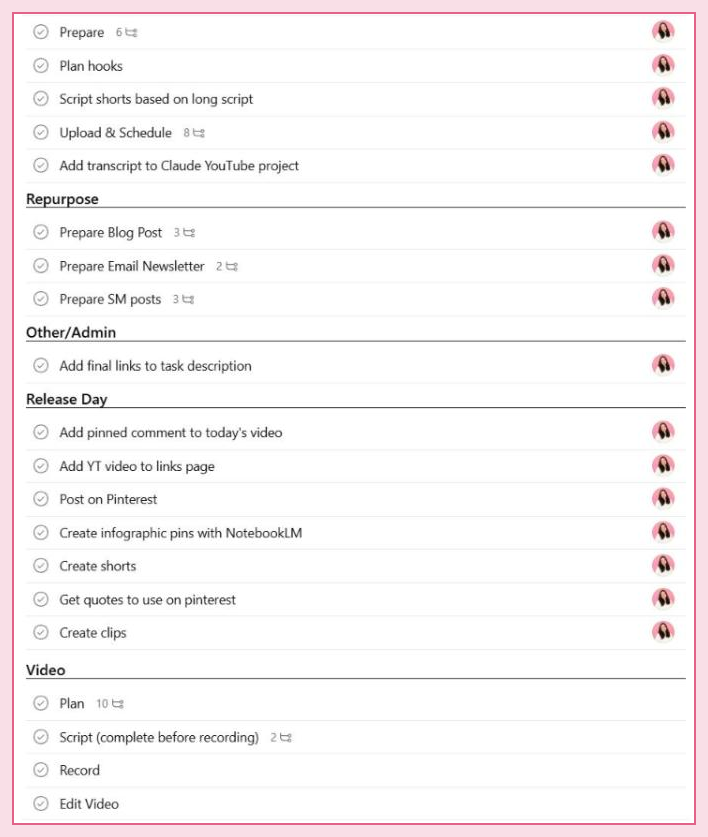
And when I'm relaunching a product, a whole bunch of steps automatically fill in, so I know exactly what I need to do for every relaunch. I don't have to sit there and decide what comes next. The task just tells me.
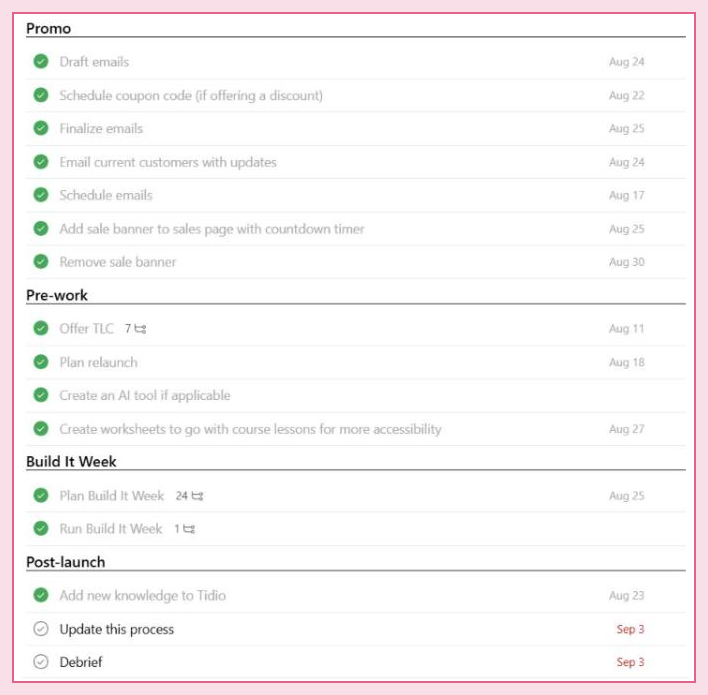
On a hard day, I'm sometimes so exhausted that I forget my own processes, the steps that need to get done, because I'm that drained. But I don't actually need to remember them, because they're already in Asana. I'm always so thankful to past me for setting them up when present me can barely think straight. (More on that in the 3 things that kept my business running when I couldn't.)
And honestly, I'm a recovering procrastinator too. I wrote every single launch email before I left for a trip once. Not because I suddenly felt super disciplined, but because my system won't let me leave it until the last minute.
How I make SOPs as easy on myself as I can
Remember my SOPs, the thing I said I avoid for no good reason? I should have way more of them done, and I put them off all the time. So I'm right there with you.
When I do sit down to prepare my SOPs, I record the walkthrough, and then I use my SOP Writer to create the rest from the video itself. That's it. It's the easiest way I've found, and it means "write the SOP" isn't one more big thing sitting there for me to avoid.
And yes, I see the irony. I literally created a tool to make this easier on myself, and I still don't always do that first step. But when I do, the rest is already handled.
The whole point
So you shrink the first step, you take the "have to" out, and you write the steps down. None of that needs you to be at 100%, and that's the whole point. It's about getting it out of your head while you can, so the task you've been avoiding doesn't keep costing you money you already earned.
And if it's not just one task, if your whole business feels like this, scattered everywhere and you're way too busy to even get started, that's a different fix. I walk you through exactly where to start in How to Organize a Chaotic Small Business When You're Too Busy to Get Organized.
Questions people ask me
Why can't I start a task I already know how to do?
It's usually not that you don't know how, and it's not that you're lazy or need more discipline. For a lot of us, the "have to" is the wall. The resistance isn't about the task itself. It's about starting it.
What's a good first step when I'm stuck?
Make it ridiculously easy, like almost silly. Instead of "write the whole script," just write the hook, record a messy voice note, or jot down three bullet points. Then count it as a win.
What is declarative language?
It's stating something instead of asking or telling. Instead of "Can you pick up your jacket?" you say "I noticed your jacket is on the floor over there." It works really well for a lot of PDAers. It doesn't work for everyone, though. I do better with direct language, so the fix has to fit your brain.